NVIDIA RTX Spark explained: what is new about local AI PCs?
Understand RTX Spark, unified memory, Windows on Arm and the distinction from DGX Spark, with availability dates, privacy limits and original diagrams.
When you ask an AI service to summarise a document, its text may travel to remote servers that produce the answer. There is another route: downloading a suitable model and running it on your computer. That approach already exists on many devices. NVIDIA RTX Spark brings a combination of graphics, computing hardware and local AI software to a family of Windows laptops and compact desktops. Understanding this development means looking at where processing happens, how memory is used and which software works, rather than reading a performance number in isolation.
This article separates confirmed announcements from planned availability and explains the practical concepts. It reflects official sources reviewed on . It is not a benchmark of hardware tested by Mira4Tech or confirmation of stock in any particular country.

What actually arrived in October 2026?
NVIDIA and Microsoft discussed RTX Spark at an event on 7 October. NVIDIA subsequently confirmed the availability of laptops from several manufacturers on 16 October. The earlier announcement scheduled compact desktops for November. A platform announcement therefore does not mean every design is already shipping everywhere. Check the exact model, sales region and delivery date before relying on a retailer listing. [1] [2]
The development is a direction in computer design: bringing AI model processing closer to the files and applications people work with. It can matter for model development and content creation. However, installing an application on capable hardware does not automatically make it use that hardware for AI, nor does it make an online service available offline.
What does running AI locally mean?
A model includes files containing values learned during training. During inference, software uses those values to generate a new output. Local inference performs that work on your device; a cloud service performs it on a remote computer. Downloading a model initially or updating its software may require internet access. That is a separate question from where a subsequent request is processed.
Consider an interview recording you want transcribed. A cloud service can receive the audio and return text. Alternatively, a genuinely local transcription program can process the recording without uploading it to that service. Our bounded Whisper experiment with an Arabic sample demonstrates the idea on existing hardware. Owning RTX Spark is not a prerequisite for understanding local inference or trying a small model that fits your current computer.
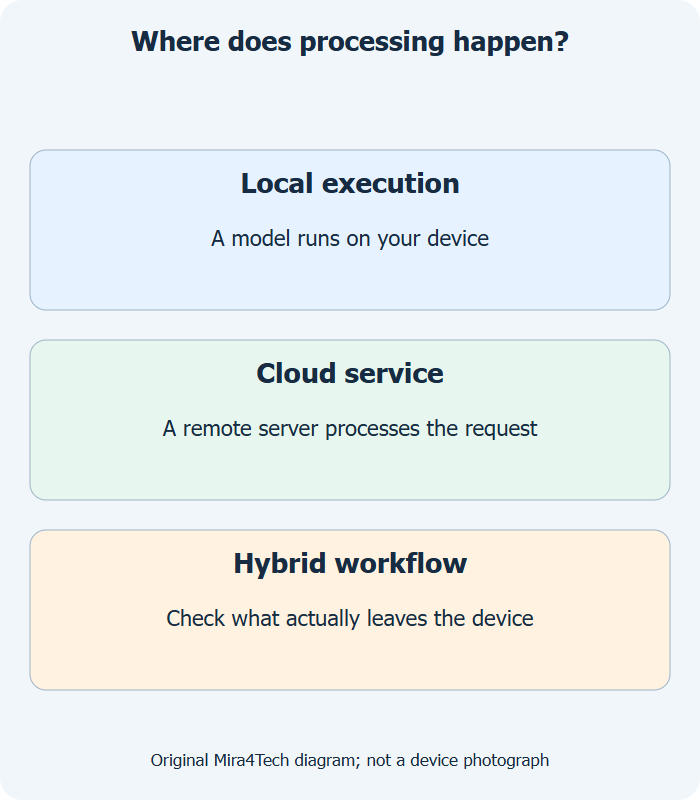
Local processing becomes useful when the available resources can deliver acceptable quality and waiting time for a particular task. Cloud services can provide access to models larger than a device can accommodate. Hybrid workflows also exist: a program might index documents locally and then send selected passages to a remote service. Having one local step does not make the entire workflow local.
What is different about the hardware?
NVIDIA documents RTX Spark as an Arm-based system-on-a-chip with Blackwell graphics and memory shared by the CPU and GPU. The CPU handles general computing and system work. The GPU helps with parallel calculations used by suitably implemented applications. Taking advantage of that combination depends on compatible software and drivers, not simply the name on the processor. [3]
The product page lists different configurations and headline limits of up to 128GB unified memory and up to one petaflop of FP4 AI performance. Those are manufacturer specifications, not measurements made by this website. The words “up to” matter: memory capacity, power limits and cooling vary by system, so a platform maximum cannot tell you how a particular laptop will behave during your normal workload. [4]
Unified memory is not SSD storage or an entirely free model budget
Unified memory is working memory accessible to relevant components under the platform's memory architecture. An SSD is persistent storage that keeps files when the computer is switched off. Being able to download a large model onto a spacious SSD does not establish that it can fit in working memory. The operating system, applications and temporary data also need resources, so total capacity is not the same as memory exclusively available to one model.
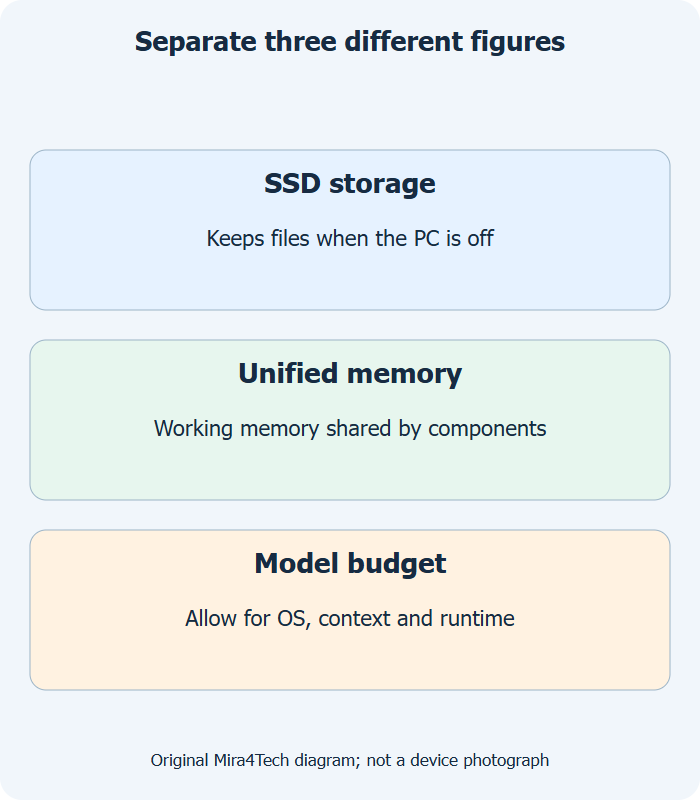
As an arithmetic illustration only, an imaginary model with eight billion values represented by four bits each needs roughly four billion bytes for those values alone: values multiplied by bits, divided by eight. This is not a memory recommendation or a measurement of a real model file. Metadata, execution buffers, context and outputs add requirements, while storage formats and compression can differ. Longer context and concurrent tasks can change the working-memory budget too.
If the terminology is unfamiliar, start with our guides to understanding RAM and checking compatibility and SSD, SATA, NVMe and M.2. They explain the concepts; they are not instructions to upgrade an RTX Spark system. Whether a particular device's memory can be upgraded must be established from its manufacturer's documentation.
Why does a petaflop figure not predict application speed?
FLOPS describes floating-point operations per second. A figure specified at FP4 describes a particular low-precision calculation format; it cannot be treated as equivalent to whole-application performance at another precision. Representing model values with fewer bits, often called quantisation, can reduce resource requirements, but preserving quality depends on the model and the task.
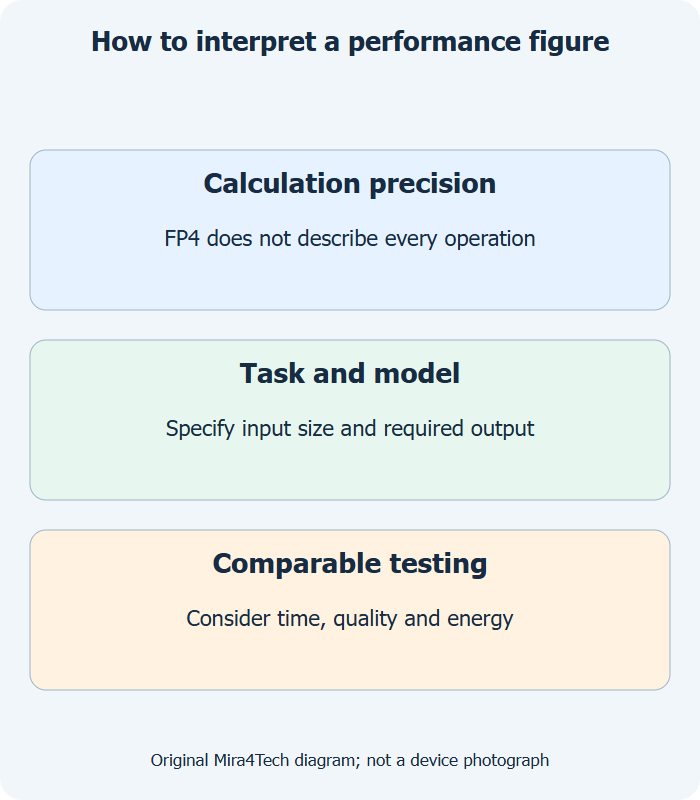
Ask which model was used, how long the input was, which precision applied, how quickly the first output arrived and how long completion took. Power consumption, noise and sustained performance can matter as well. A system that is faster at image generation is not necessarily faster by the same ratio at document translation or software compilation. A meaningful comparison needs stated conditions and reproducible results rather than unrelated headline figures.
Windows on Arm: check software and drivers carefully
A familiar Windows desktop does not establish that the underlying processor architecture is identical to a conventional x64 PC. Microsoft explains that device drivers must support Windows on Arm. Some games can also be affected when their required anti-cheat drivers lack support. Emulating an application does not turn an x64 driver into an Arm64 driver. [5]
List the tools and peripherals you actually depend on: an editor and its plug-ins, a capture device, a printer and work applications. Check each publisher's support information for the model, software version and architecture. Test a complete workflow rather than just launching the application. Its interface may open while an extension or export function fails. An unknown driver or disabled protection is not an appropriate workaround for missing compatibility.
Does local processing make files automatically safe?
Avoiding an upload removes one data-sharing step, but you still need to understand what the program does. Check whether the selected feature runs a local model or calls an external service, and whether connected accounts, synchronisation or extensions affect the workflow. A network connection used to download model files is different from one used to send document contents. Neither a local label nor the mere presence of a connection answers every privacy question.
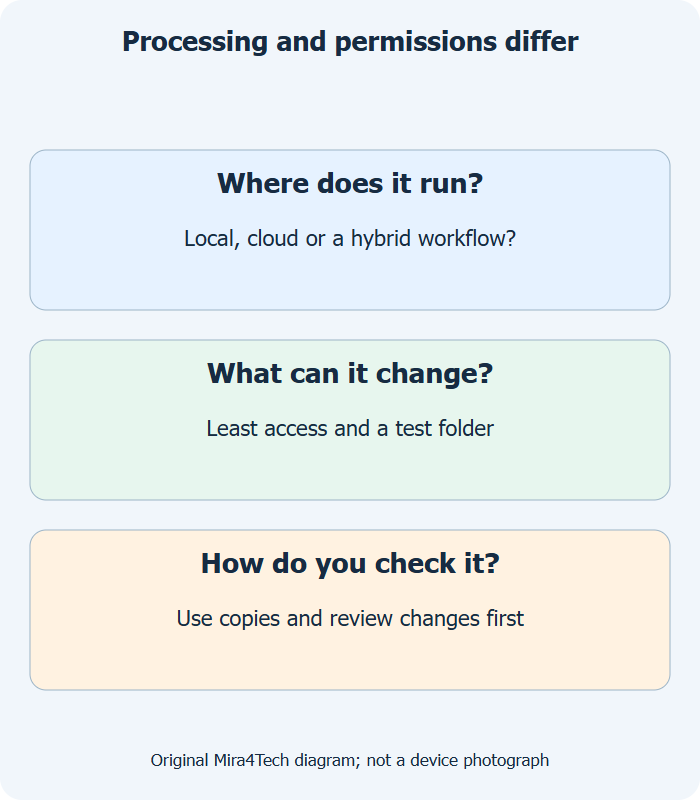
A writing assistant that suggests text is also different from an agent allowed to change files or take actions. Begin with a test folder and copies of data, and inspect changes before applying them to originals. Local inference is not a reason to grant mail, payment or deletion permissions indiscriminately. Answers can still be wrong: changing the location of a model does not make its statements reliable. See writing clear prompts and reviewing the output for a practical checking approach.
RTX Spark, DGX Spark and the next questions to ask
The names are similar, but NVIDIA's comparison distinguishes Windows-based RTX Spark from Linux-based DGX Spark and places DGX Station in another system category. Do not transfer one product's specifications or setup instructions to another because both names include Spark. Identify the full product name, operating system and actual configuration. [6]
To evaluate the development, define one task and the quality, privacy and waiting time it requires. Try what can be done with trustworthy software suitable for your current computer, then compare that experience with independent testing of a specific prospective device. This makes it easier to judge whether more memory or local acceleration solves a real problem. This article establishes neither local retail pricing nor measured performance, and buying new hardware is not a requirement for benefiting from AI.
Questions that clarify the announcement
Will every AI application work offline on RTX Spark?
No. The application needs a supported local execution mode and compatible model. A service that processes requests on its servers remains cloud-based even when accessed from powerful hardware.
Is 128GB unified memory the same as a dedicated graphics card's memory?
It is shared under the platform architecture, not automatically 128GB reserved exclusively for graphics. Compare the application's usable memory, the system design and other resource requirements rather than capacity alone.
Does this development make other computers obsolete?
No. It is a platform development for local processing, not the invention of local AI itself. The suitability of existing hardware still depends on the task, software and memory, and useful comparisons require real testing.
Sources and the limits of this article
We reviewed these sources on 2026/10/28. Announcement dates are separate from this article's publication date. Our diagrams explain general concepts; they are not device photographs or benchmark results. We have not tested RTX Spark hardware or checked local retailer stock.
- NVIDIA: Windows and RTX Spark announcement, 2026/10/07.
- NVIDIA Newsroom: laptop availability, 2026/10/16.
- NVIDIA: RTX Spark architecture, Arm and shared memory.
- Official RTX Spark product page and listed configurations.
- Microsoft: Windows on Arm FAQ and driver compatibility.
- NVIDIA Developer: local AI platforms and their operating systems.