Ultrathin materials for lower-power AI chips: what does the research show?
Understand Brown’s ultrathin bismuth ferrite research, lower-power memory concepts and the gap between a materials result and a working commercial chip.
Could lower-power AI chips start with a change in the material itself? Before a faster processor becomes possible, there is a smaller problem to solve: a useful laboratory material can lose its function when it becomes thin enough for electronics. This article builds the idea from the beginning and separates a significant materials result from a component you can buy for your computer.
What is new, and when was it announced?
On , Brown University announced a way to prepare thin bismuth ferrite films that retain important electrical and magnetic properties. The work relates to possible lower-power electronics; the announcement does not introduce a commercial processor or measure the electricity saved by a complete computer. Source: Brown’s release.
The useful question is what was actually measured. Characterising a small layer, operating a memory cell and building millions of cells with their supporting circuits are different achievements. Each stage introduces questions that the previous stage could not answer. We will therefore start with what the material does and then examine its connection to AI without jumping directly to promises about future computers.
Understand the terms before thinking about chips
Electrical polarisation describes an arrangement that separates positive and negative charge within a material. In a ferroelectric material, a suitable electric field can switch the polarisation direction. The name does not require the material to contain iron; it describes behaviour. Think of an arrow that can point in two directions. Its direction represents the information, rather than its size or the number of atoms drawn beside it.
Magnetic order concerns how atomic magnetic moments are arranged. Not every magnetic arrangement behaves like a refrigerator magnet that visibly attracts metal. A material with more than one kind of ferroic order is described as multiferroic. For electronics, the useful question is whether the relationship between those states can perform a function, rather than whether two attractive terms appear in the same description.
A thin film is a layer prepared on a supporting surface called a substrate. It is not a sheet to cut with scissors or a sticker to place on top of an existing processor. Interfaces, atomic arrangement and electrical boundary conditions become part of the system’s behaviour. A supported layer can consequently behave differently from a large piece of the same nominal material.
How can engineering the layers help?
Brown’s release describes two complementary ideas: compressive strain imposed by the substrate and a conducting layer that helps manage electric fields. In a simplified reading, the film’s surroundings are engineered to preserve its function, rather than assuming that reducing thickness is enough. Brown’s explanation of the preparation.
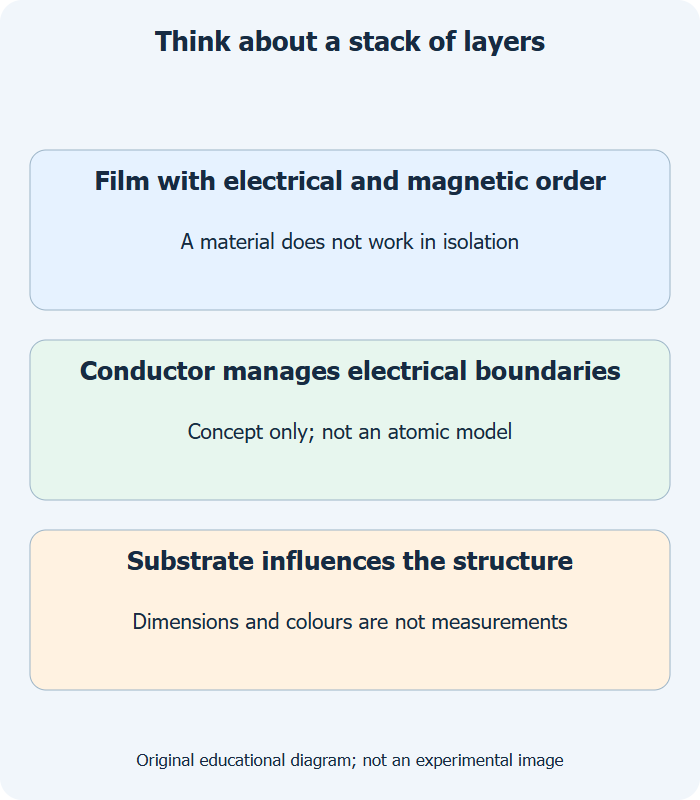
To understand the structural idea, imagine a row of regularly spaced pieces fitting over another row whose spacing is slightly different. This is an analogy for a constraint, not a literal account of atomic motion. The supporting surface can do more than hold a layer in place: it can influence its crystal geometry. Meanwhile, charges at the boundaries need an appropriate electrical environment so that they do not oppose the desired state.
This is why it helps to think about a stack of interacting layers instead of a material name alone. A different interface, growth quality or measurement condition calls for renewed verification. The same habit is useful beyond this story: a component’s label does not determine its performance in isolation, just as RAM capacity alone cannot describe every aspect of a computer’s speed.
How does that connect to storing zeros and ones?
A memory needs two distinguishable states and ways to write and read them. Depending on the technology, a state might be represented by charge, polarisation or magnetic order. Writing changes the state on demand; reading identifies it without destroying the information. Retention asks whether the distinction persists for a useful time without having to be recreated continuously.
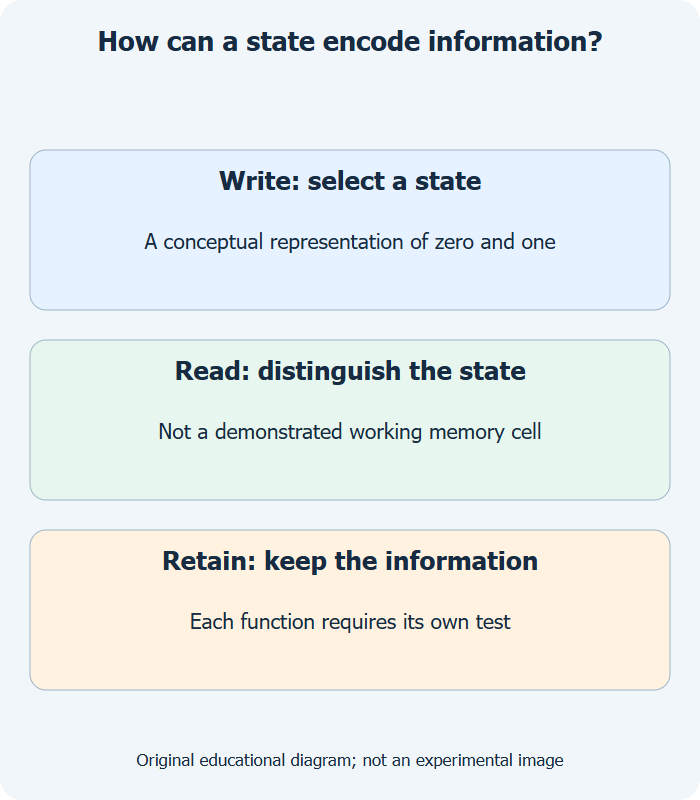
The diagram explains information encoding; it is not a memory cell demonstrated by this team. Ask three separate questions: can a state be selected, can it be read reliably, and does it remain stable? Encouraging evidence for one question does not automatically answer the other two. This is more informative than describing every advance in a material as a ready-made memory technology.
A lower switching voltage can be useful, but voltage alone does not determine a system’s energy consumption. Capacitance, operation count, leakage, driving circuits, sensing and data movement also matter. One small operation can become less expensive while other parts continue to consume energy. A material result therefore cannot be converted into a percentage reduction in a data centre’s electricity bill without testing the working system.
What does the paper establish, and what remains open?
Nature Materials published the study on 28 October 2026. An author manuscript first appeared in January and was revised on 24 October. Results include films four unit cells thick and altermagnetic signatures. The manuscript identifies conclusive voltage-driven reversal as a next step, with rapid depolarisation a limitation. We read the available manuscript, not the full subscription version.
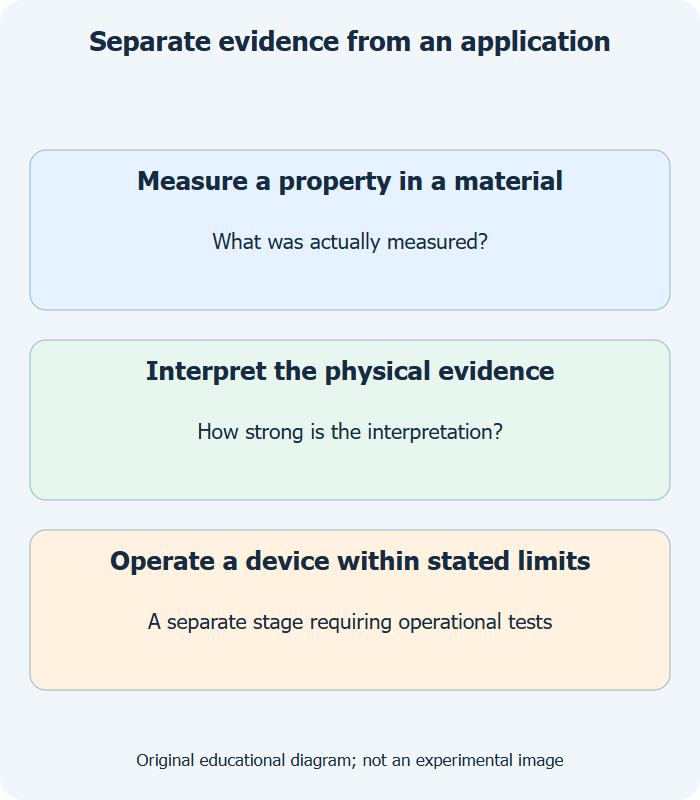
A crystal unit cell is not a memory cell. The first is a repeating unit in a crystal; the second is an engineered element with writing and reading functions. A small number describing crystal thickness is not automatically a processor manufacturing node, transistor count or processing speed. Keeping the units attached to their meaning prevents comparisons between numbers that happen to look similar but describe different things.
Likewise, the word “signatures” expresses a level of evidence rather than an inconvenient detail to conceal. A structural or magnetic measurement supports a physical interpretation, whereas an operational component needs additional kinds of tests. We explain the evidence that is available; we have not reanalysed the laboratory’s raw data or independently reproduced the experiment.
Why does this matter for AI?
Running a model involves more than calculations. Parameters have to be stored, data has to be read, and information moves between parts of the machine. This makes memory and logic research relevant even when no new AI algorithm is involved. Divide the picture into computation, storage, communication and cooling, then ask which part a proposed invention addresses before forecasting the effect on the whole computer.
However, a relevant research field does not make every material suitable for every job. Memory near a processor has different requirements from long-term storage; a battery-powered device differs from a server operating continuously. A choice can be attractive for one task and complicated or expensive for another. The same use-based reasoning applies when choosing a compatible SSD instead of judging it by its technology name alone.
What would have to happen before a product?
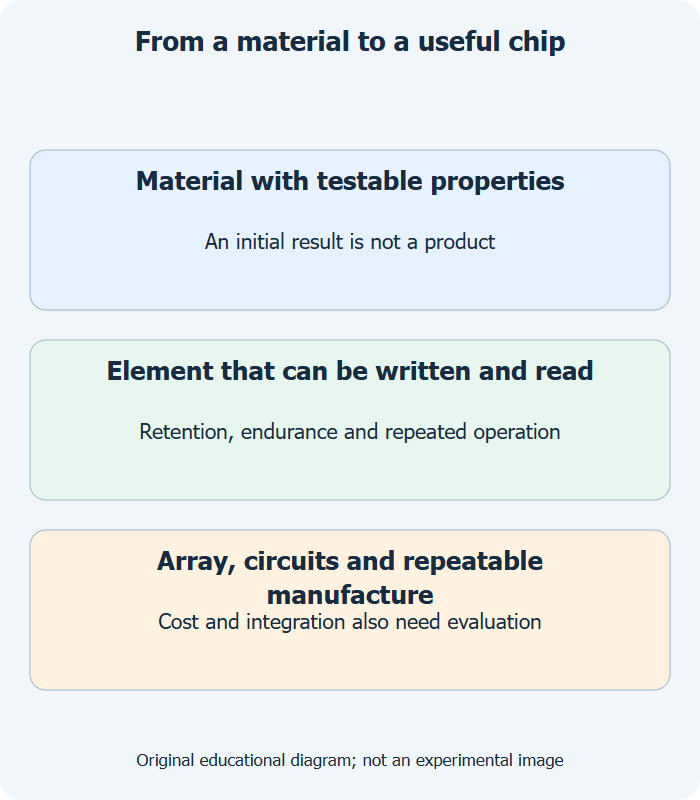
A material must lead to an element that operates repeatedly, followed by groups of elements that can be manufactured consistently. Practical questions include readable states, retention, switching endurance and operation at the required temperatures. This is a general evaluation framework for memory technologies, not a list of tests we claim this particular study passed or failed.
Interconnects, packaging, cost and manufacturing yield come next. An excellent result in a small region does not guarantee comparable quality across a large chip. Integration into a computer also needs suitable interfaces, testing methods and software for the proposed function. These steps explain why a research publication date and a product availability date must be kept separate. We do not invent a commercial timetable that a reliable source has not announced.
What can a computer owner use today?
This story does not call for a driver update or a purchase bearing the material’s name. The immediate benefit is a way to evaluate chip news: identify the material, its proposed function, the measurement and the remaining questions. If your goal is to run models on a computer available now, read our explanation of local AI and RTX Spark. That is a different decision from evaluating a material for a future component.
Apply the same questions to claims about a processor that supposedly consumes no power. An exaggerated phrase is not a useful result. Ask for measurement conditions, the comparison baseline and whether a figure refers to one element or the whole machine. Following inventions then becomes a way to build understanding instead of collecting incompatible promises every week.
Questions that often cause confusion
Can this material be added to my existing processor?
No. The work concerns materials preparation and electronic engineering, not a user-installable upgrade or performance utility.
Does lower energy always mean greater speed?
No. Energy, latency, capacity and stability are different measures. A useful comparison runs the same task and states the boundaries of the device being measured.
Are the illustrations microscope images from the study?
No. They are original educational diagrams, not sample photographs or measured curves. Consult the paper for the original research figures and their usage terms.
Sources and how this explanation was prepared
The Mira4Tech Team reviewed Brown’s release, the journal publication page and abstract, and the v2 author manuscript. Reviewed on . The conceptual explanations, analogies and diagrams are our own. We did not conduct a physical experiment or power benchmark, and did not copy the research figures into this article.