An AI robotic laboratory: how does it help discover heat-resistant materials?
Understand Nottingham’s robotic laboratory, active-learning coating research and the gap between preparing a sample and qualifying an aviation product.
An AI system can suggest a promising material composition, but a suggestion does not produce a sample that can be tested. Quantities still need to be measured, liquids mixed, a sample transferred into a furnace, and the result cooled and examined. University of Nottingham researchers are connecting parts of that journey in a coordinated robotic laboratory, reducing reliance on manual handling between repeated experimental operations.
The related materials goal is to investigate candidates for thermal barrier coatings, which help protect components in demanding hot environments. This article explains the integration of robotics and software, the role of AI in selecting candidates, and the distance between a successful laboratory demonstration and an aviation-qualified product. Sources were reviewed on . Mira4Tech has not operated this laboratory or independently reproduced its results.
What was announced, and when were the studies published?
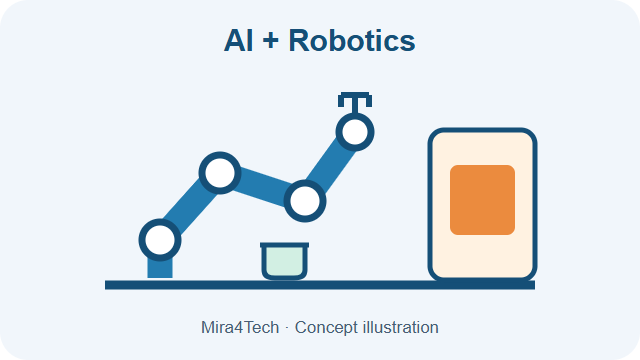
A University of Nottingham release published on 26 October 2026 described work at its Centre of Excellence in Coating and Surface Engineering to link material preparation, sample handling and thermal processing. It describes two robotic arms, laboratory equipment and coordinating software, alongside active learning to help identify compositions worth investigating. The development concerns connecting physical experimentation with computational planning more effectively. [1]
The release points to two distinct works. A robotic-workflow manuscript was posted to ChemRxiv on 8 October as a preprint. A separate, earlier peer-reviewed study in Engineering Applications of Artificial Intelligence concerns active-learning materials discovery. The release date is therefore not the first publication date of every result. Nor should the two studies be treated as a single experiment simply because one announcement discusses both. [2] [3]
Why investigate a coating that withstands heat?
A thermal barrier coating is not ordinary decorative paint. It is a layer or coating system that limits heat transfer into an underlying component. NASA's work in this field also emphasises monitoring coating erosion, separation and temperature: protection can deteriorate even when the basic insulating concept is sound. [4]
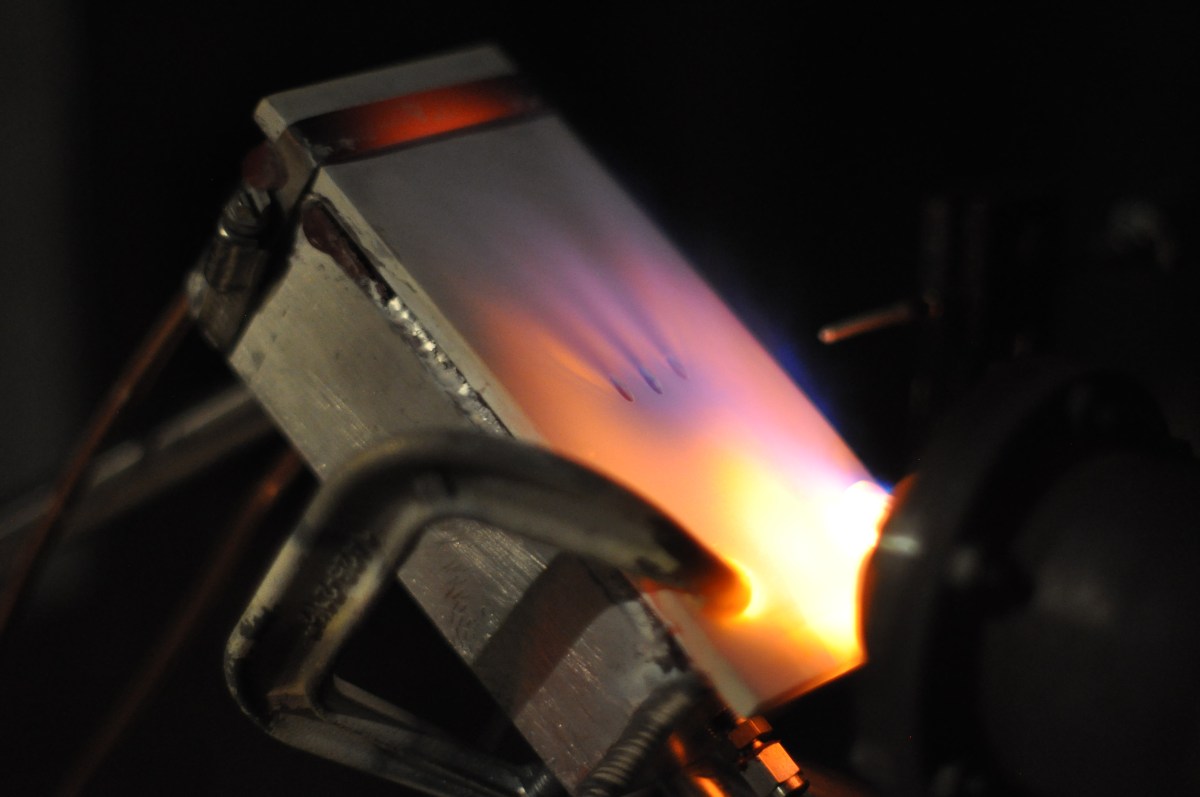
Imagine a barrier between a hot source and a component that needs protection. Low thermal conductivity is useful, but insufficient if the barrier cracks or detaches as temperatures change. The question is therefore broader than whether a material survives one impressive temperature. Researchers need to understand how it performs as part of a working coating system over time. The image illustrates coating testing; it does not connect NASA's experimental results to Nottingham's system.
How does a digital recipe become a physical sample?
A useful digital recipe translates an experimental plan into operations that equipment can execute. Choosing a chemical composition does not specify everything else. The correct quantities need to reach the correct container, and the sample's identity must remain traceable during transfer and processing. Otherwise, a measurement could be attributed to the wrong candidate.
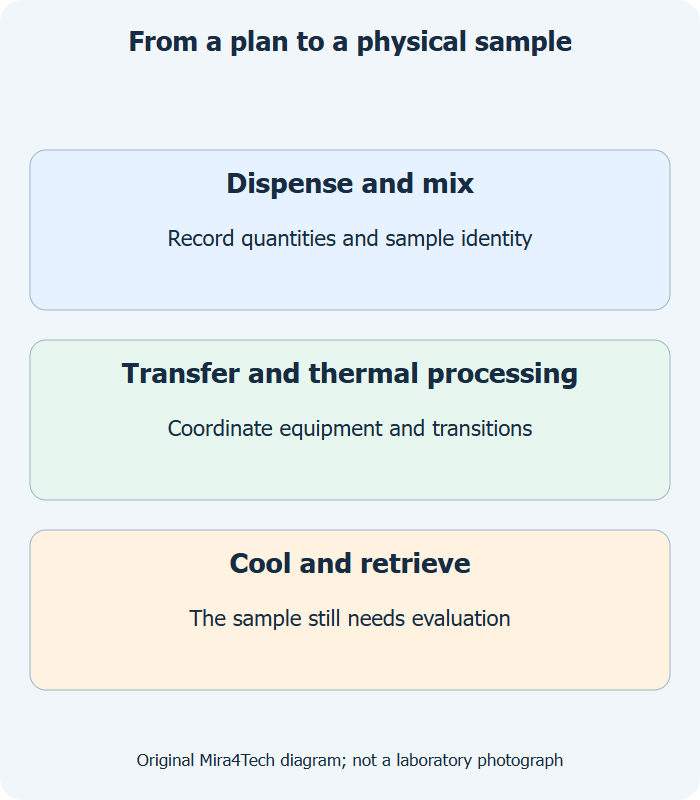
The robotic paper's author abstract describes coordinated liquid dispensing, mixing, transfer, furnace loading, thermal treatment, cooling and retrieval. A Python-based architecture connects the components; this is more than running two arms independently. The abstract describes testing the complete workflow through synthesis of gadolinium zirconate, with furnace processing at 1600°C. That is a reported processing temperature, not an approved continuous operating temperature for a coating inside an engine. [2]
Consider the difference between a machine executing one operation and a chain in which each operation depends on the previous one finishing correctly. Advancing merely because a timer has elapsed can be inappropriate if the actual state is different. Defining and recording transitions is part of making an automated process inspectable. This illustrates the coordination problem; it is not a claim about a particular safety circuit in the published platform.
Why does a robotic system still need calibration?
Repeatable motion alone does not establish that the dispensed quantity is correct. A system can reproduce the same deviation consistently, making results appear orderly while a calibration error persists. Repeatability and closeness to the intended quantity are different questions. The robotic abstract describes calibration with liquids of different physical characteristics, a relevant distinction because settings suitable for one liquid need not transfer unchanged to another. [2]
A scale that gives a stable reading above the true weight offers a useful analogy: consistency helps reveal change but does not remove bias. Laboratory work also requires traceable containers, materials and operating records. When reading about automated experiments, ask what was actually measured and how the quantities were checked rather than assuming robotic handling eliminates error.
What does AI select, and what do the robots execute?
Active learning uses existing observations to help choose informative additional experiments. A model estimates how candidates might behave, selected candidates are tested, and the new measurements can inform another round of selection. This requires a measurable target and data connecting a composition to an outcome. It is different from asking a general chatbot to invent a material name.
The associated peer-reviewed study investigates multicomponent oxides with a pyrochlore structure and thermal-conductivity properties relevant to coating research. A crystal structure concerns the arrangement of atoms, not merely the sample's visible shape. Its abstract reports that candidates from a later selection round formed two phases after synthesis. That is a useful reminder that proposing a composition does not guarantee the desired structure will form. [3]
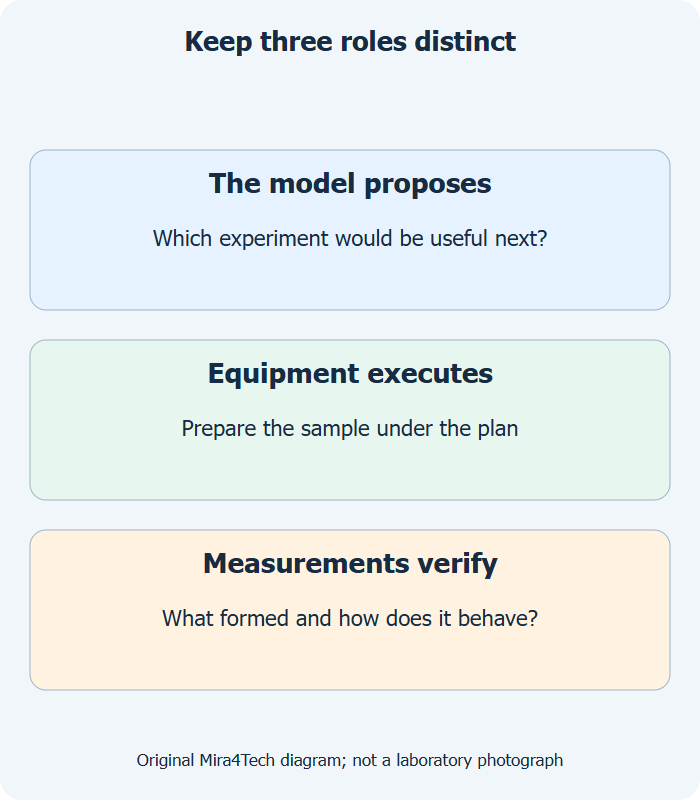
Keep three roles distinct: a model proposes, equipment prepares, and measurements establish what resulted. Each can involve different tools and software. A fully closed discovery loop should only be claimed when the described system demonstrates how measurements feed back into choosing the next experiment. A demonstration of robotic movement by itself does not establish that entire loop.
What do the results establish, and what remains to be shown?
According to its author abstract, the robotic work demonstrates a coordinated preparation, processing and recovery workflow in the reported experimental setup. The materials study examines another question: can candidate selection help identify compositions worth synthesising and evaluating? Success in one part does not automatically establish success in the other, and neither should be presented as certification of a commercial aviation coating.
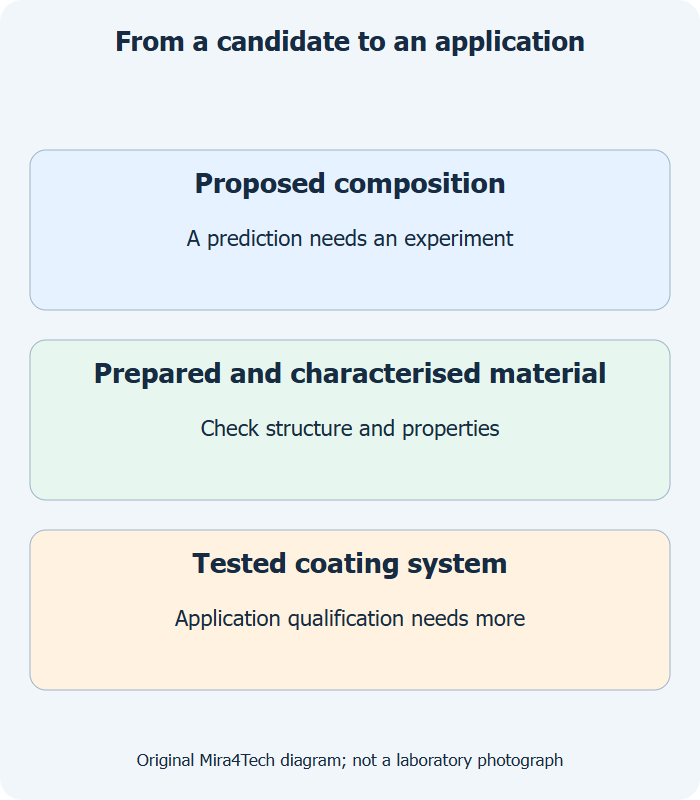
A candidate material needs characterisation to establish what actually formed, followed by tests relevant to its intended function. A coating system's behaviour in service is a separate question from making a powder or a sample in a furnace. NASA's work monitoring coating loss, separation and temperature distributions illustrates why discovering a candidate is not the end of performance validation. [4]
We do not infer a particular time saving, superiority over every laboratory or a commercial cost from this announcement. Nor do we turn the reported processing temperature into a continuous-service rating. Such comparisons need stated test methods, conditions and an appropriate baseline. Separating those claims preserves the significance of the research without turning it into a promise unsupported by the sources reviewed here.
Is this the first robotic laboratory, and why does it matter?
Self-driving laboratories are an established research area extending beyond this project. Scientific literature describes linking experimental design, preparation, measurement and analysis through feedback, while highlighting challenges in instrument integration, maintenance and software generality. We therefore assess this development in terms of connecting preparation and high-temperature processing rather than calling it the world's first automated laboratory. [5]
The interesting shift for a general reader is from a digital proposal to a physical experiment that can be inspected. More experiments do not guarantee useful results, but well-measured and well-documented experiments can make exploration more systematic. Defining a worthwhile question, investigating exceptions and interpreting evidence remain scientific work even when machines perform many repetitive operations.
For another view of software meeting hardware, read our RTX Spark and local AI explainer. That article asks where calculations execute; this one asks how computational choices become physical experimental work. In both cases, distinguish an advertised capability from an outcome actually demonstrated.
Questions that help interpret the announcement
Did a robot independently discover an aircraft-ready coating?
The reviewed sources describe robotic preparation and candidate-material research. They do not establish aviation qualification of a commercial coating without researchers, or completion of every industrial validation stage.
Does 1600°C specify an approved service temperature?
The robotic abstract reports it as a furnace processing temperature in the described experiment. That figure alone does not establish a coating's service rating, lifetime or resistance to thermal cycling.
Is a preprint the same as a peer-reviewed study?
They represent different publication stages. We distinguish the robotic preprint from the peer-reviewed materials study rather than presenting every part of the announcement as having undergone the same review.
Sources, images and review limits
Sources were reviewed on 2026/10/28. Our account of Nottingham's robotic experiment draws on the author abstract registered with Crossref and the university release, not a reanalysis of raw data or an independent replication. The NASA photograph provides background on coating tests. Other diagrams are original explanatory artwork rather than photographs of the laboratory. Mentioned institutions do not sponsor or endorse this article.
- University of Nottingham release published by Phys.org, 2026/10/26.
- Dezaki and colleagues: robotic-workflow preprint, posted 2026/10/08; publisher metadata and author abstract in Crossref.
- Chowdhury and colleagues: active-learning pyrochlore discovery, Engineering Applications of Artificial Intelligence, 2026; university repository abstract and study record.
- NASA Glenn: monitoring protective coating temperature and condition; NASA editorial image-use guidelines.
- Moran, Xu and Abolhasani: The rise of robotics in self-driving labs, 2026. Consulted for context; its images are not reproduced.