SMB 0x80070035: Network Path Not Found When Opening a Share
Windows could not reach the requested network-share path. Understand the context and follow diagnostic checks and verification, with an original diagram and official references.
This guide explains the message in context, walks through focused checks and verifies the outcome. The website does not run commands on your device; choose an appropriate action after understanding its conditions.

What the message means
The path-access attempt failed, but this does not by itself prove an incorrect password or a need for SMB1. The hostname, share name, network reachability and SMB requirements can all matter. Separate reaching the share from authorisation to use it.
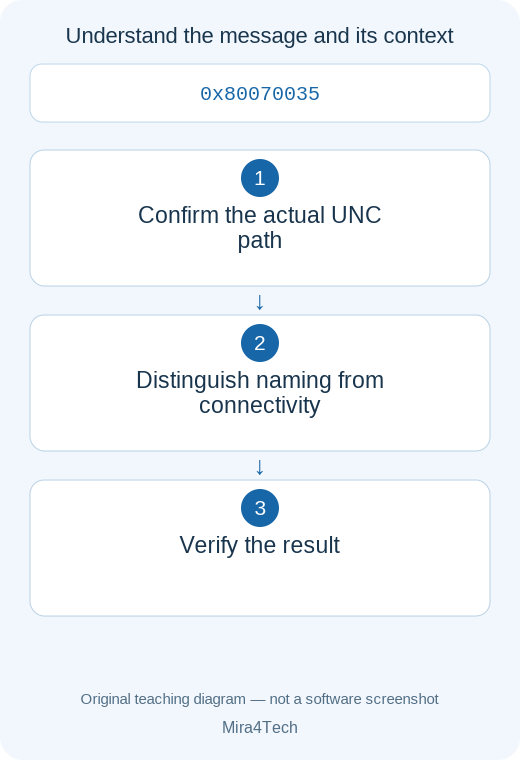
Prepare a controlled check
Keep the message, time, app or device name and version. Save work and use a non-sensitive training file when testing. Start with an observable check, change one factor and record the result. On a managed device, follow your authorised access and organisation policies.
Step 1: Confirm the actual UNC path
Ask the share owner for the server and published share names. Use a UNC path with two initial backslashes. A disk folder’s name can differ from its share name; a documentation example is not your actual server address.
Step 2: Check host and network availability
Confirm that the host is running and that you are on the intended network or required work VPN. Do not mark an untrusted public network Private simply to test. Ask the administrator about permitted access instead of exposing sharing to the internet.
Step 3: Distinguish naming from connectivity
Use the linked diagnosis guide to inspect hostname resolution. With administrator guidance, compare a documented IP path where appropriate, noting that authentication behaviour can differ. A successful ping does not prove that SMB or the share is available.
Step 4: Review share publication and scoped rules
Have the host owner confirm the published share and appropriate File and Printer Sharing rules for a trusted network. Keep the firewall enabled. If the result changes to access denied, switch to the permissions case rather than continuing reachability changes.
Step 5: Check modern SMB compatibility
For a NAS or older appliance, review firmware and support for authenticated access and signing. Use the vendor’s secure supported configuration rather than enabling SMB1, guest access or disabling signing because the code appeared.
Verify the outcome
Open the intended share and read an authorised test file. If write access is required, use an owner-approved training location and reopen the saved file. Seeing a computer in Network or reaching its address does not prove complete share access.
When to stop and seek help
Stop before exposing SMB publicly or weakening authentication and signing, or when share ownership and permitted access are unclear.
Two questions before another change
Is the code alone enough to choose a remedy?
No. The location and circumstances must match this guide. If a new code, message or stage appears, record it and establish its context before another action.
What evidence should I give support?
Provide the product and version, error and time, attempted checks and observed results. Redact passwords, recovery codes, identities and personal files. Verify a support provider before granting remote control.
Related practical guides
Sources and scope
Prepared and edited by the Mira4Tech team. The checking sequence uses documented message meanings and product guidance; it is not a claim of testing your device or proving one cause for every occurrence. Interface labels can vary with version and language.