A semiconductor chip for enzymatic DNA synthesis
A Harvard-led team combines electronic control with enzymes to write different DNA sequences at multiple sites. The experiment points to a chemical bottleneck as well as an opportunity for electronics.
What did the June study show?
The Nature Electronics paper, published on 17 June 2026, describes a CMOS chip with 256 pairs of ring electrodes. The team demonstrated up to 64 distinct sequences, each 38–39 nucleotides long, and encoded a 169-byte text. These numbers refer to different things: available electrode sites, demonstrated distinct sequences, strand length and the size of one encoded example. [1]
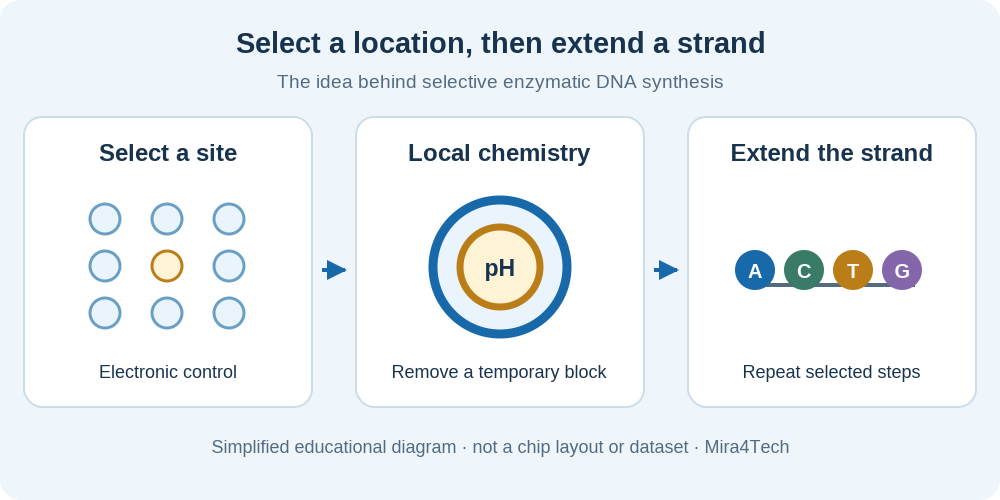
DNA writing, reading and the electronic chip
DNA uses an alphabet of four bases, commonly abbreviated A, C, G and T. A sequence is their order along a strand. Synthesis builds a strand; sequencing reads its order. A chip that helps synthesize DNA therefore performs a different task from a sequencing instrument, even though both may use electronics and enzymes. [4]
CMOS is a widely used way to make semiconductor circuits. Here, the electronics control reactions at small locations on a surface. They do not turn silicon itself into DNA. Think of the chip as an addressable controller and the DNA as the material being assembled at its selected addresses.
How does electrical control guide a biochemical reaction?
In stepwise enzymatic synthesis, a temporary chemical block prevents a newly extended strand from immediately growing again. Removing that block prepares it for another addition. [1]
Electrical control of concentric electrodes can make selected sites acidic while helping contain the acidity. Changing the selection during successive cycles allows different sequences to grow. [3]
The important idea is spatial selectivity. If every location were activated together during every step, it would be difficult to write different instructions at neighbouring sites. The controller must choose where a reaction happens, as well as when it happens. Earlier work from the same research programme demonstrated arrays that could control and monitor local pH, providing context for the synthesis experiment. [3]
The bottleneck was not simply the number of pixels
Harvard reports that denser attempts revealed a chemistry problem: intermediate molecules involved in removing the blocking group could travel to nearby sites. Localizing acidity did not fully localize those intermediates. The proposed next direction is chemistry with more direct local acid action. More electronic addresses alone would not resolve that cross-talk. [2]
This distinction matters whenever a digital controller meets a physical process. Software can select an address precisely, but molecules can move through a shared solution. Scaling requires the physical reaction to stay selective enough for the intended density. It is an engineering constraint, not a reason to assume that additional chip area automatically produces usable DNA.
Why mention data storage?
Encoding a text demonstrates a connection between digital symbols and molecular sequences. A usable DNA archive would also require encoding rules, quality control, storage conditions, retrieval and sequencing. The small text example does not establish a complete storage service, its price, or its read and write speed. It is one demonstration within a synthesis study.
NHGRI explains that synthetic biology uses synthesized DNA to help engineer biological functions. Such uses depend on sequence quality and how the output is processed. [5] A synthesis platform is not, by itself, a validated medical test or treatment. The immediate scientific question is whether it can produce the intended strands reliably at useful scale.
Questions readers ask
Why are there 256 electrode pairs but only 64 demonstrated sequences?
A controllable site count describes hardware capability. The number of distinct sequences successfully demonstrated is a separate experimental result, affected by the chemical process and the selected arrangement of sites.
Does a correct decoded text mean every molecule was perfect?
A recovered message is a system outcome. Assessing synthesis requires examining errors and the distribution of DNA products, as well as the decoding method; a single output example cannot substitute for those measurements.
What should the next milestone report?
Useful evidence would connect higher density with sequence accuracy, length, yield, repeatability and total processing time. These measurements help show whether a larger array produces more useful output.