SPEARS batteries: what NASA’s extreme-cold tests actually showed
NASA’s 14 October 2026 report describes solid-state prototype cells for demanding lunar environments. Their operating temperatures and their survival temperatures are different results.
Read the temperature results precisely
NASA reports SPEARS cells operated between −60°C and 80°C, with reduced performance down to −80°C. The agency reports survival after exposure from −170°C to 100°C. Surviving the colder condition means the cell could recover afterwards; it does not mean it delivered usable power while at −170°C. The cells require warming back to an operating temperature. [1]
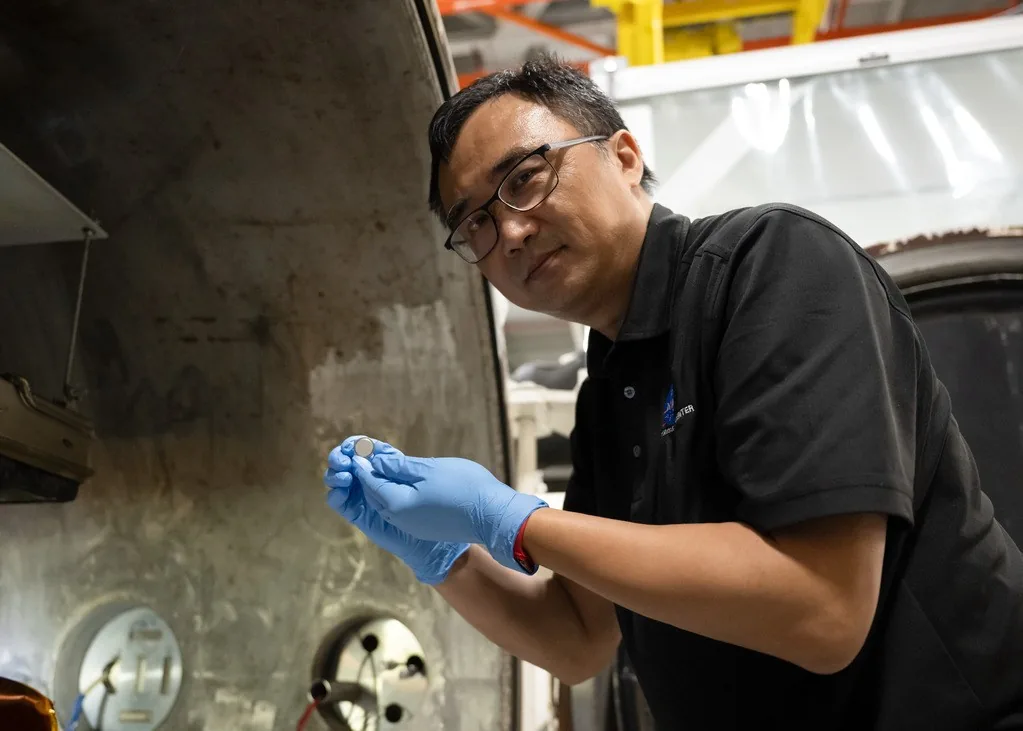
What makes a battery “solid-state”?
A battery converts chemical energy into electrical energy. Ions move internally between its electrodes, while electrons supply current through the external circuit. The electrolyte provides the internal ion-transport medium. Replacing a liquid electrolyte with a solid changes that pathway; it does not remove the need for chemical reactions, electrical connections or a suitable operating temperature. [2]
In the SPEARS work, NASA describes ceramic- or polymer-based solid electrolytes. “Solid-state” names a class of designs, rather than one universal battery recipe. Different electrode and electrolyte combinations target different requirements. [1]
Why test temperature and vacuum together?
Thermal vacuum testing combines low pressure with hot and cold conditions. NASA’s testing guidance describes checking system functions at temperature plateaus during thermal cycles. This helps distinguish a component that remains physically intact from a system that performs its intended task in the relevant environment. An ordinary freezer test at room pressure answers a narrower question. [3]
Three phrases deserve separate readings: “operated at” describes function during exposure; “survived” describes recovery or lack of damage after exposure; “qualified” would concern satisfying a defined set of requirements. A test report should identify which of these claims its measurements support. The SPEARS announcement is a development report, with flight preparation still ahead.
Why lunar engineers care about the result
A battery that can tolerate a cold dormant period could change how a mission budgets heat and energy. The complete system still has to pay for warming, useful operation and losses. The practical comparison is total mass and energy over a mission’s duty cycle, rather than one minimum temperature. This is the engineering reason to separate surviving storage from supplying power.
NASA’s earlier SABERS programme investigated solid-state batteries for aviation, where both stored energy and rapid delivery of power matter. It offers useful background on why battery design involves several tradeoffs. Its reported performance figures describe that earlier project and should not be transferred to SPEARS without evidence. [4]
From a coin cell to a dependable power system
A small cell is one element of a larger battery system. Moving toward a mission also requires suitable packaging, connections, control electronics and predictable behaviour across repeated use. NASA Johnson lists distinct battery performance, abuse, vibration, thermal vacuum and other test capabilities. That range illustrates why one successful temperature experiment cannot answer every reliability question. [5]
Useful follow-up evidence would include the load supplied at each temperature, operating duration, charge and discharge cycles, capacity loss, sample-to-sample variation and the energy needed for recovery. Those details would let engineers judge whether the prototype meets a particular mission’s needs. The announcement does not establish a consumer release date or a universal replacement for current batteries.
Questions readers ask
Did NASA make a battery that runs at −170°C?
The report distinguishes survival at that temperature from operation. Its lowest reported operating temperature is −80°C, with reduced performance.
Does solid-state mean zero heating equipment?
No. The reported approach still uses warming to bring a very cold cell into an operating range. The potential benefit concerns how much thermal management a mission needs.
Will this improve phone batteries immediately?
The announcement concerns research prototypes and spaceflight preparation. Transfer to a consumer product would require a suitable design, manufacturing process and product-level validation.