Bifur-circuits: printed modules that change shape and stay connected
A set of research building blocks makes shape part of an electronic interface. Understanding the geometry and the sensing separately helps explain what these “smart” structures can actually do.
What did MIT announce?
MIT’s 27 August 2026 report describes Bifur-circuits: printed modules that stay electrically connected as their configuration changes. Demonstrations include furniture with several forms and a controller whose shape selects different interactions. The work explores reconfigurable objects and interfaces; it is not a product launch. [1]
A mechanical metamaterial in plain language
A mechanical metamaterial obtains unusual behaviour from its repeating geometry. “Auxetic” structures can become wider when stretched, rather than narrowing in the familiar way. Earlier MIT CSAIL work explored this behaviour in structures whose size and shape change through twisting. It provides background for understanding geometry as part of a material’s function. [3]
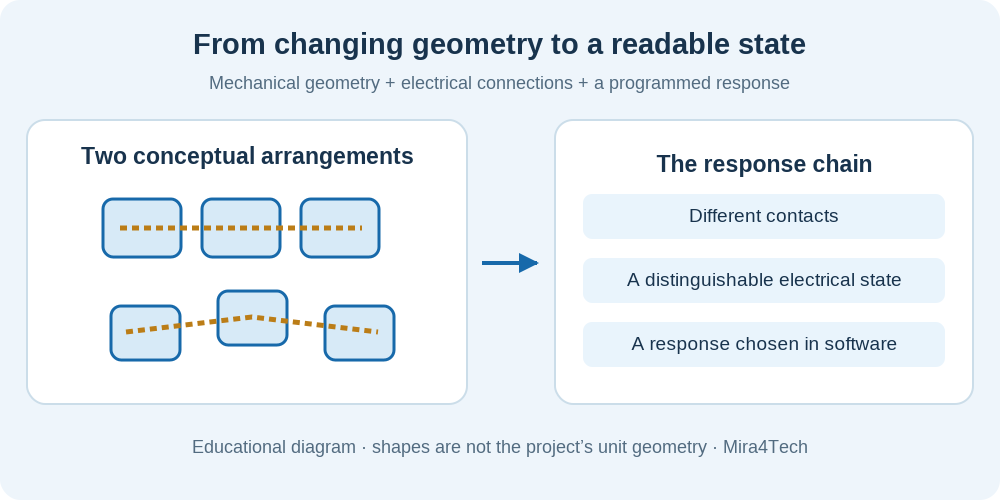
The word “bifurcation” describes a change from one pattern of behaviour into alternative configurations beyond a threshold. For intuition, picture a folding mechanism that can settle into more than one arrangement. The research uses carefully designed connections and rotation; the educational drawing above explains the relationship between shape and signals, rather than the exact mechanics of its units.
How can an object recognize its own shape?
The project embeds conducting paths whose contacts reveal a configuration. Connector electronics map neighbouring units; software recognizes the resulting assembly. [2]
Consider a hypothetical teaching tool with an “open” and a “closed” arrangement. If the contacts reliably distinguish those states, a programme could show different information for each. The example illustrates a design principle; the behaviour depends on the programmed mapping. Calling the object smart does not establish that it understands a user’s intentions.
Why geometry belongs in the explanation
Earlier KinetiX research at MIT used rigid plates and elastic or rotating hinges to create tunable deformation. Combinations of units could produce changes such as bending, shearing and rotation. This is useful context: the shape-changing behaviour can be designed into the structure itself. Adding sensing raises a further question—whether electronics can identify that structure’s state reliably. [4]
These are separate capabilities. A structure may change shape without sensing it; a sensor may detect motion without carrying a useful load. A practical interactive object has to combine the necessary capabilities for its intended use. This is why a visually impressive transformation is only one part of the engineering story.
What do the test results establish?
The project reports maintained electrical connectivity through 10,000 compression cycles in its evaluated samples. It also reports a roughly five-second discovery time for a twenty-unit chain. These are specific endurance and latency results, rather than a general lifetime guarantee or an instantaneous response for every assembly. [2]
For an interface, a delay can change the experience. A slow discovery step may be acceptable while a user rearranges a room model, yet troublesome for an interaction that demands immediate feedback. This comparison is an application question, not a judgment that the same delay is always good or bad. The relevant requirement depends on the task.
Power, durability and applications
Printed-conductor resistance limits power distribution. The prototypes use local batteries on circuit boards. Electrical continuity therefore needs to be distinguished from delivering useful power. [2]
MIT discusses possible assistive devices and robotic grippers as future directions. Such uses would need their own evidence for loads, contact reliability, response time and safe repeated handling. A connectivity test does not establish the complete mechanical life of furniture or the suitability of a medical aid. The current value is a research toolkit for exploring how modular geometry and electronics can work together. [1]
Questions readers ask
Do the blocks move themselves?
The cited demonstration concerns reconfiguration and recognition. Do not infer autonomous actuation from the ability to sense a shape.
Do more possible shapes mean better sensing?
More configurations expand design choices, but the sensing system still has to distinguish the states relevant to an application. Variety and recognition reliability are different measures.
What should a useful follow-up show?
Look for realistic tasks, repeated assembly, sustained battery operation and response-time measurements in the intended configuration. Those results would connect a versatile prototype with a dependable everyday interface.